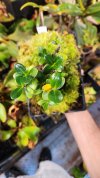
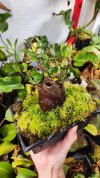
Hydnophytum caminiferum and some other ant plants

I thought S. kajewskii could be found even higher up than 600m, at around 1000m?

I did get more than one S. guppyana and S. kajewskii, I'll try one in the warm tent and one at a position in my cold tent that may be on the warmer side, although asking around I've had a grower tell me they grow their S. kajewskii very warm. with no issues.

The rest I have left in my warm tent.
 
I have only recorded specimens between 100m and 700m, no higher, but well maybe there are some higher.
Bougainville Island is an island with an equatorial climate, so I expect temperatures between 24-35°C.
 
I have only recorded specimens between 100m and 700m, no higher, but well maybe there are some higher.
Bougainville Island is an island with an equatorial climate, so I expect temperatures between 24-35°C.
Andreas lists guppyanum and the guppyanum x kajewski hybrid as highland on his website — do you think his classifications aren’t accurate?
Not challenging your claim, just trying to figure out the best source of temp data for these guys :]
 
For my part, I base my work on the documents of Jebb & Huxley and on some information from people who have been to Bougainville and Shortland Island.
 
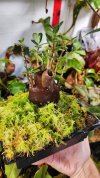
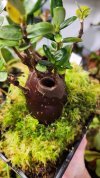
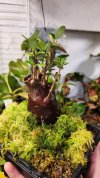
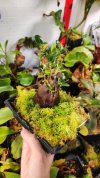
This is my Kajewski that I got from Wistuba around 2 yrs ago. I have been growing it in HL conditions along with my nepenthes. I dont really fertilize it and I would like to know what type of fertilizer can I use?
1000078420.jpg
 

Attachments

  • 20260513_120145.jpg
    20260513_120145.jpg
    1.5 MB · Views: 96
  • 20260513_120153.jpg
    20260513_120153.jpg
    1.2 MB · Views: 83
  • 20260513_120206.jpg
    20260513_120206.jpg
    1.3 MB · Views: 98
Found a photo of the same plant from 2 years ago
 

Attachments

  • Screenshot_20260517_092126_Instagram.jpg
    Screenshot_20260517_092126_Instagram.jpg
    500.6 KB · Views: 108
I use Schultz orchid fertilizer at the lower concentration they recommend. I squirt it into the holes, 3 cc daily for two to 3 days every few weeks.
 
I use two types of NPK fertilizer depending on the plant: adult or juvenile:
Juvenile NPK: 12-32-14 + trace elements
Adult NPK: 13-19-19 + trace elements
This is necessary to compensate for the loss of nitrogenous substances from ants (prey and excrement).
I apply them either as a spray on the leaves or caudex, or by watering the substrate.
Sometimes, to boost a weak plant, I use a fresh, highly nitrogenous fertilizer such as NPK 23-5-5 (for green plants).
 
This is my Kajewski that I got from Wistuba around 2 yrs ago. I have been growing it in HL conditions along with my nepenthes. I dont really fertilize it and I would like to know what type of fertilizer can I use?
High K fertilizers with a good dose of Magnesium improves the growth and color greatly. Via soil, usually do 800 ppm. No need for high N as it just worsens any potassium issues.
 
For me, on the contrary, the nitrogen content in a fertilizer should be significant. To compensate for the nitrogen (N) released by the ants.

An NPK fertilizer is: nitrogen (N) for growth, phosphorus (P) for root development and potassium (K) for flowering, fruiting and resistance.

In principle, one looks for a substantial caudex and proper roots in these Rubiaceae plants; the fruits and flowers are secondary.
 
Hydnophytum Caminiferum from AW
 

Attachments

  • 20261006_170529.jpg
    20261006_170529.jpg
    1.5 MB · Views: 52
  • 20261006_170428.jpg
    20261006_170428.jpg
    1.3 MB · Views: 43
  • 20261006_170410.jpg
    20261006_170410.jpg
    1.4 MB · Views: 44
  • 20261006_170522.jpg
    20261006_170522.jpg
    1.3 MB · Views: 42
  • 20261006_170503.jpg
    20261006_170503.jpg
    1.1 MB · Views: 41
  • 20261006_170516.jpg
    20261006_170516.jpg
    1.4 MB · Views: 48
I grow it in a mix of coco husk chips/perlite and sphagnum. It is a quite airy mix but it doesn't seem to mind staying wet for long periods
 
Back
Top